Polluting sponsorship casts shadow over Milano-Cortina 2026
Updates, notes and useful links


Hello everyone,
January is over - and what a month it’s been.
The UK has seen record-breaking rainfall, with historic levels in some places and flooding across Europe, Indonesia and Afghanistan. Elsewhere, extreme heat has boiled Australia, driven drought in Kenya, and fuelled wildfires in Chile, Argentina and South Africa.
This is the reality of our changed climate.
Let’s spend the rest of the year working to make sure that we - and the sports we love - can thrive in a hotter, more unpredictable world.
Next online Cool Down gathering will take place on Wednesday 4 March, 11am (UK). Email me at cooldown@newweather.org.
Within Sport
❄️ It’s Snow Joke
The ‘Olympics Torched’ report from the New Weather Institute, in collaboration with Scientists for Global Responsibility and Champions for Earth, set the tone early with some damning data on the scale of the threat facing winter sports. The report found that, based on official data and excluding the emissions related to sponsorship deals with major polluters, the Winter Games will cause greenhouse gas emissions of about 930,000 tonnes of carbon dioxide equivalent (tCO2e), with the largest contribution from spectator travel. In the coming years, these emissions will cause a loss of approximately 2.3 square kilometres of snow cover and over 14 million tonnes of glacier ice. These are major impacts on exactly the environment that enables winter sports to take place.
The emissions impact of Milano-Cortina becomes even more shocking when you take into account the uplift in emissions associated with the Winter Games three main sponsors: fossil fuel giant Eni, carmaker Stellantis and ITA Airways. According to the analysis, these sponsorship deals will induce an additional 1.3 million tonnes of carbon dioxide equivalent (tCO2e) – about 40% more than the rest of the estimated carbon footprint of the event and enough to melt 3.2 square kilometres of snow cover and cause the loss of over 20 million tonnes of glacier ice. With figures like this, the continued presence of polluting industries as major sponsors of winter sports is totally untenable. Forbes has a great write up of these tensions.
🥶 A frosty reception for fossil fuel sponsors
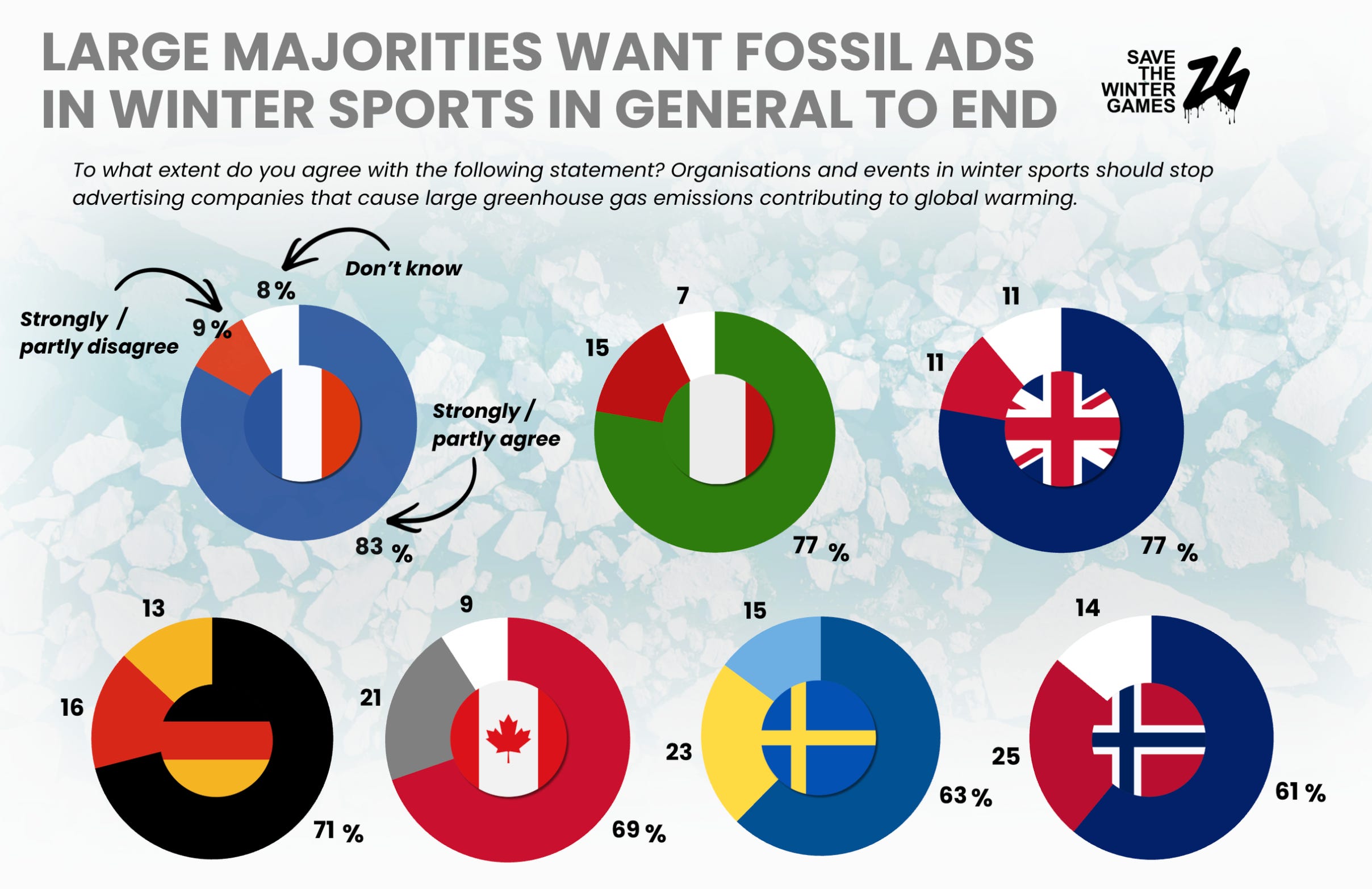
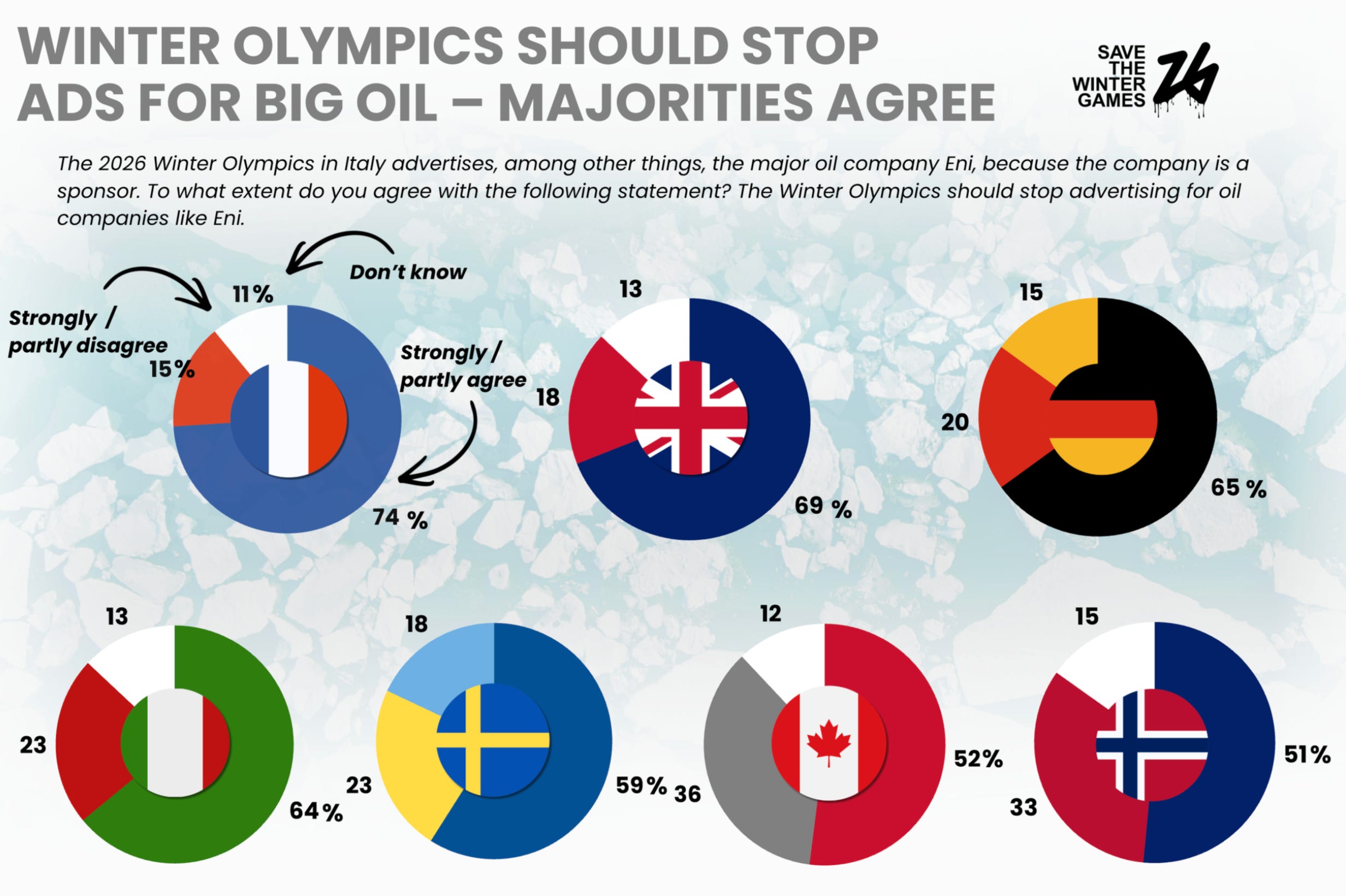
It’s not just emissions arithmetic that puts the sponsors of Milano-Cortina on thin ice - there is a growing sentiment from the public that it is not right. Brand new international polling reveals an overwhelming public concern about the loss of snow and ice due to global heating, and strong support for ending fossil fuel advertising in winter sports.
The polling, conducted across seven leading winter sports nations in Europe and Canada, shows large majorities of the public, and even bigger majorities of winter sports fans, believe the Olympics and winter sports more broadly should stop advertising companies driving the climate crisis. These findings expose a stark disconnect between the values of audiences and the commercial partnerships underpinning elite winter sport. Understandably, the media has picked up on this growing and unignorable sentiment amongst the public.
🧊 Thin ice for the IOC?
This is difficult terrain for the International Olympic Committee (IOC) to navigate. And to make matters worse, a raft of letters have been sent their way. Fossil Free Ski has brought together winter athletes and organisations to call out the IOC and specifically for the sponsorship partnership with fossil fuel Eni. The letter notes that “we believe that by associating winter sports with fossil fuel companies, we risk normalising the connection between our sports and the detrimental effects of the product that they sell”. The signatories “demand that the FIS and IOC publish a report evaluating the acceptability of fossil fuel sponsorships in winter sports competitions by the onset of the 2026/27 season.”
Hot on the tail of this letter, Greenpeace International have also sent a letter to the IOC which, at the time of writing, has around 21,000 signatures. The letter rightly notes that “climate-wrecking fossil fuel giants are using a global sporting event to cleanse their public image and distract the world from the damage they’re causing to our planet.” The letter demands that the IOC “drop oil and gas sponsorship from the Winter Olympic and Paralympic Games - and commit to ending fossil fuel sponsorship across all Olympic Games”. Letters are well and truly back in fashion - and they work. Kirsty Coventry, the President of the IOC, issued a response saying that the IOC must “be better” on climate.
📺 Snow Shows
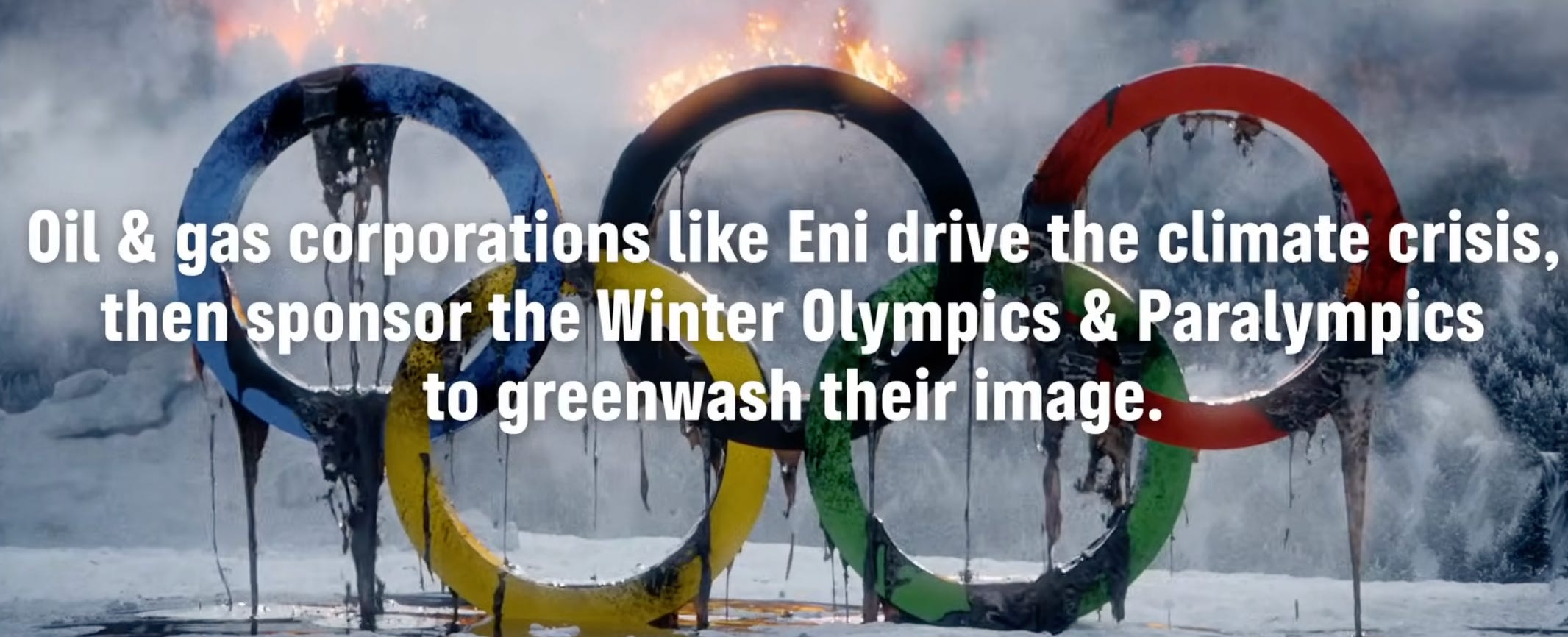
There have also been a series of fantastic videos that nail the insanity of the Winter Games being sponsored by big polluters in different ways. First up, the Save Our Snow crew have this beautiful short film talking to athletes and families about the importance of snow to their lives and the incongruence of polluters sponsoring the Winter Games. It is well worth your time. Greenpeace hit a different tone with their hard-hitting parody video, nailing the OILympics. As always, Greenpeace pulls no punches.
🎓 Where next for the Winter Games?
Academics Daniel Scott, Robert Steiger and Madeleine Orr have published an excellent paper on the Winter Olympics and Paralympics. The authors argue that the climate crisis is fundamentally threatening the future of the Winter Olympic and Paralympic Games, requiring urgent adaptation strategies. The authors contend that two priorities must be addressed before 2038:
Shifting the Paralympic Winter Games to more climate-reliable months. Currently scheduled in March, the Winter Paralympics face much higher climate risk than the Olympics (held in February).
Embracing snowmaking as essential. Rather than criticising artificial snow, it should be recognised as indispensable to the Games’ future, with focus on making it more sustainable (it’s currently very energy- and emissions-intensive).
The authors also weigh up the resilience of 93 potential host locations for the Winter Games, finding that for:
The Winter Olympics (February): 45-55 locations climate-reliable in 2050s; 30-54 in 2080s.
The Paralympics (March): Only 17-31 locations climate-reliable in 2050s; 4-31 in 2080s.
These findings present several headaches for the IOC and the governance of the Winter Olympics and Paralympics.
First, the current model is incompatible with our warming world. The “one bid, one city” Winter Games framework established in 2001 and extended through to 2032 is totally unsustainable. With only 17-31 locations climate-reliable for Paralympics in the 2050s versus 45-55 for Olympics, the current February Olympics/March Paralympics format drastically limits viable hosts and, by extension, the viability of the games.
Second, urgent decisions are required before the 2038 bid process begins. There are three options available (I think) which would all involve a major governance overhaul:
Merge the Games? This, of course, creates logistical nightmares such as more housing/transport and extending the competition from 16 to 20-24 days, as well as risking the Paralympic events being overshadowed.
Separate the Games? This could be a return to pre-1992 format but again would threaten Paralympic visibility, sponsorships, and financial stability.
Temporal shift? Bring both Games forward by 2 to 3 weeks, which appears most promising but has a range of unexplored implications.
The bottom line is that the IOC’s governance model needs to be made resilient to climate change. Instead of its flexible guidelines for host countries, climate change will force it to introduce binding requirements (like artificial snow making). The historic ‘single-city hosts’ may present too much of a risk if temperatures and snowfall fall victim to climate chaos, so a revolving or rotational hosting may make more sense. Most importantly, though, is the need for much more proactive planning and mandatory climate and environmental measures to ensure the Winter Games do not melt the snow it relies upon. And this must include ending the promotion of polluting companies, such as Eni.
Climate delay in global sport
There’s another great paper penned by Pascal Stegmann and Manuel Suter. The paper argues that elite sports perpetuate climate inaction through various “delay discourses” - narratives that justify inadequate climate action despite the sector’s environmental impact and societal influence. The authors identify a critical contradiction that many readers will be all too familiar with: while sport has high social relevance and could be a powerful force for climate action, it instead deploys narratives that maintain an unsustainable status quo.
The paper found three major claims from those in the sports industry:
System entrapment vs. individual responsibility. Athletes and staff that took part in the research claim to be “trapped” in the climate-damaging sports system while simultaneously suggesting climate action should be voluntary and individual.
Sports exceptionalism. Elite sport is viewed as inherently apolitical and deserving of exemption from climate responsibilities, though this does not hold up to any real scrutiny.
Dual dimensions required. Addressing climate delay requires tackling both cognitive/psychological barriers AND structural/systemic changes.
The study concludes that elite sport operates as a “climate laggard rather than role model” despite its potential influence. The sector deploys sophisticated delay discourses that maintain a performance-driven, growth-oriented logic while avoiding the transformative change that sport is well-placed to accelerate.
Beyond Sport
❌ Amster-ban
Amsterdam has quietly raised the bar for climate action, and set a new gold standard while it’s at it.
The Dutch capital has passed a local law banning polluting advertising in public spaces. From 1st May, ads promoting fossil fuels, flights, petrol and diesel cars, gas heating contracts and meat products will no longer appear on billboards or across the city’s public transport network.
It’s not coming out of nowhere. Last year, the Dutch cities of The Hague, Delft, Nijmegen and Utrecht introduced similar bans through local ordinances. But by following suit, Amsterdam becomes the first capital city anywhere in the world to make the move.
Here in the UK, cities are edging in the same direction. Edinburgh and Sheffield have gone furthest, with councils like Cambridgeshire, Coventry and Medway introducing partial restrictions. The difference, though, is stake. These interventions in the UK are just the first step and are, in practice, policy choices rather than law. Amsterdam’s approach has real teeth: the rules are written into legislation, and companies that break them can be fined.
The world of sport is watching these developments closely because they will undoubtedly impact the events and teams hosted within these cities.
🙏 Any good news?
Yes, thankfully.
A few bright spots to start 2026:
👉 EVs outsold petrol cars in the EU for the first time.
👉 Global green tech investment hit $2.3 trillion.
👉 UK solar installations up 37% year-on-year.
👉 Australia reached 50% renewable electricity.
👉 Germany’s top court ordered stronger climate action from the government.
Progress isn’t linear, but it is happening.
Until next time,
Freddie / Cool Down